Devotional 13 January 2026
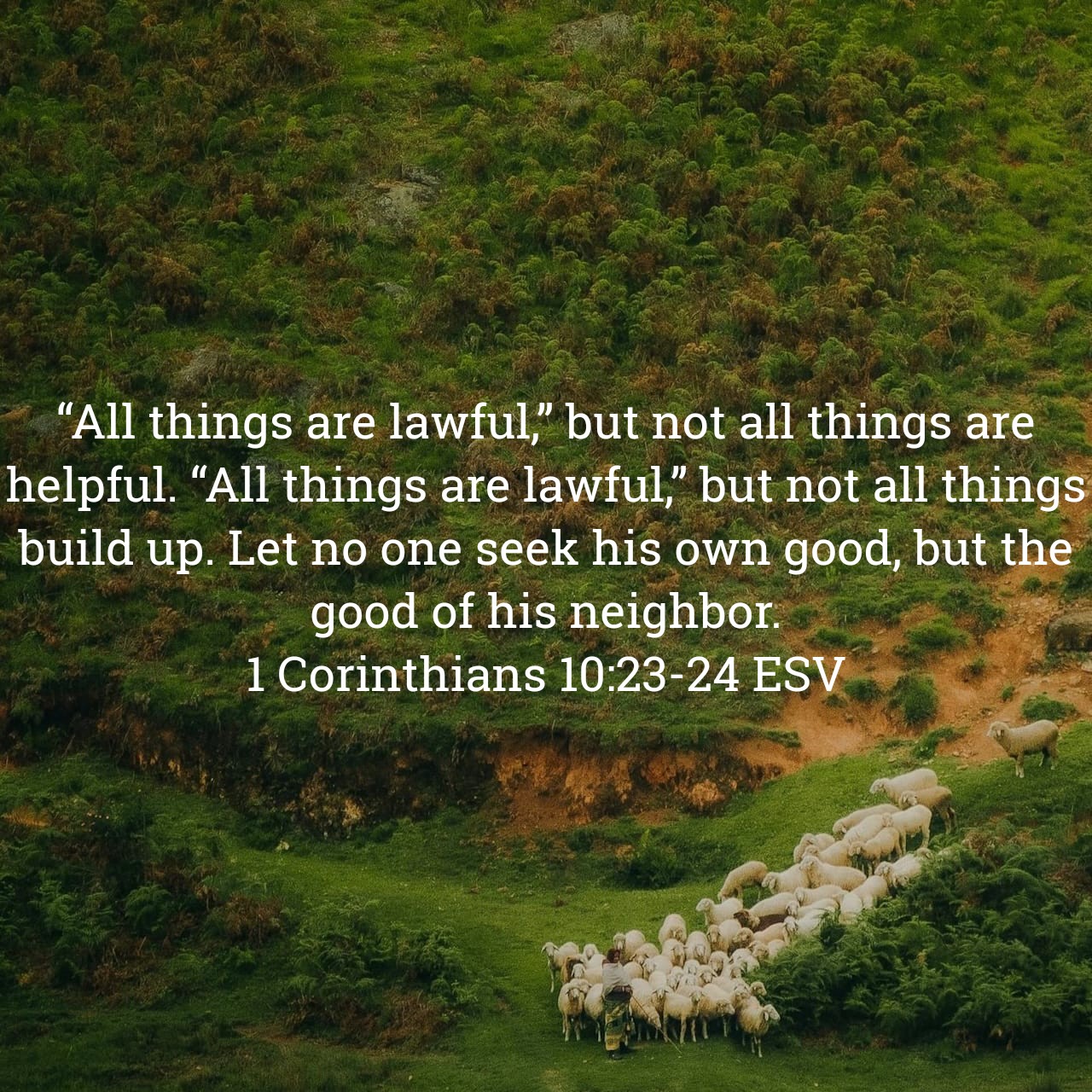
Paul confronts two errors that feel very modern. One treats morality as people-pleasing: If no one is upset, it must be fine. The other treats freedom as isolation: If it’s lawful for me, no one else matters. Paul rejects both.
The question he presses is not, “Will my neighbor dislike this?” but, “Will my neighbor be built up by this?” Christian love is not driven by emotional comfort or social harmony. It is driven by edification.
The Corinthians were correct that many things are lawful. Paul does not deny that. But he insists that freedom alone is an insufficient guide for Christian living. Freedom must be governed by love, and love aims at strengthening faith, not merely asserting correctness. As he has already warned, liberty can become destructive when it is exercised without regard for the conscience of others (1 Corinthians 8:9–13).
This is where Paul’s teaching becomes uncomfortable. A believer may be right about what is permissible and still wrong in how that freedom is used. When our actions pressure another Christian to act against their conscience, we are not helping them mature. We are weakening them. “Whoever has doubts is condemned if he eats, because the eating is not from faith” (Romans 14:23). What begins as confidence can become a stumbling block.
Paul’s concern is not to protect perpetual immaturity. The goal is growth. But growth must be patient, loving, and Christ-shaped. Knowledge alone does not build the church; love does (1 Corinthians 8:1). The body grows “when each part is working properly” for the good of the whole (Ephesians 4:15–16).
Ultimately, this ethic is grounded in Christ Himself. “Let each of us please his neighbor for his good, to build him up. For Christ did not please himself” (Romans 15:2–3). The Son of God had every right, yet He laid them down for our salvation (Philippians 2:3–8).
Christian freedom is real, but it is never self-directed. Because we belong to Christ, our lives are lived before Him and for one another. The question is not merely Can I? but Does this help my brother or sister walk more faithfully with Christ?